 ★ Featured review

Kayla B. ✓ Verified
Bridge programme
★★★★★
It explains before it tells
Fifteen minutes on my phone is a whole lesson, and it is done.
 Free NCLEX Handbook
Order: "Oh Oh Oh To Touch And Feel Very Good Velvet, Ah Heaven" gives you the 12 nerves from I to XII.
Sensory or motor: "Some Say Marry Money, But My Brother Says Big Brains Matter More". S is sensory, M is motor, B is both.
| Nerve | Type | Bedside test |
|---|---|---|
| I Olfactory | Sensory | Eyes closed, one nostril at a time: name a familiar smell. |
| II Optic | Sensory | Snellen chart at 20 feet, near card at 14 inches. |
| III Oculomotor | Motor | Pupils (PERRLA), eyelid lift, the six cardinal fields of gaze. |
| IV Trochlear | Motor | Cardinal fields of gaze, together with III and VI. |
| V Trigeminal | Both | Cotton wisp on forehead, cheek and jaw; clench while you feel the jaw muscles. |
| VI Abducens | Motor | Cardinal fields of gaze, looking out to the side. |
| VII Facial | Both | Smile, frown, puff the cheeks, raise the brows; taste on the front of the tongue. |
| VIII Vestibulocochlear | Sensory | Whispered voice test for hearing, Romberg for balance. |
| IX Glossopharyngeal | Both | Say "ah", gag reflex, then a swallow (tested with X). |
| X Vagus | Both | Uvula rises in the midline, gag reflex, swallow, voice. |
| XI Accessory | Motor | Shrug and turn the head against your hands. |
| XII Hypoglossal | Motor | Stick out the tongue: it should stay in the midline. |
That is three purely sensory nerves (I, II, VIII), five purely motor (III, IV, VI, XI, XII) and four mixed (V, VII, IX, X).
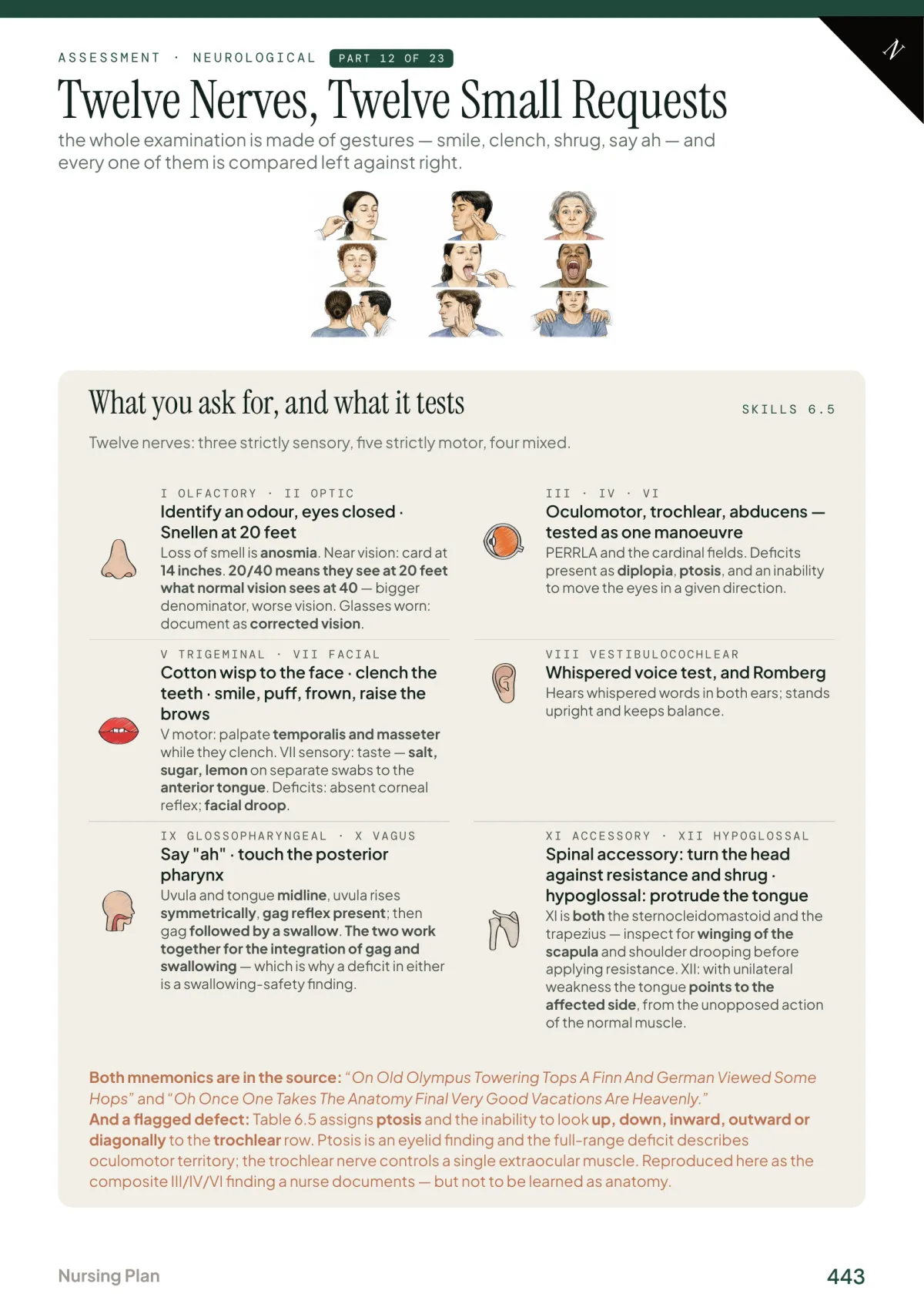
This is 1 of 2,936 illustrated sheets. Get all 4 volumes free, just cover the $7.95 processing.
$7.95 processing today, includes 30 days of app access, then the app subscription continues unless you cancel. All terms shown before checkout.
Exam questions rarely ask you to recite the list. They give you a patient, a finding and a nerve, and ask what it means or what you do next. Three patterns come up again and again.
Every test in the table is done on both sides. A droop on one side of the face, a pupil that reacts more slowly, a shoulder that will not lift: the finding is the difference between the sides, not the movement itself.
The glossopharyngeal and vagus nerves work together for the gag reflex and swallowing. A weak gag or a wet, gurgly voice after a sip means aspiration risk. After a stroke, check them before anything is given by mouth.
When one hypoglossal nerve is weak, the healthy side pushes the tongue over, so it deviates toward the affected side. The same logic helps with facial nerve findings: the droop is on the weak side.
One widely used table places ptosis and the inability to look in every direction in the trochlear row. Ptosis is an eyelid finding from the oculomotor nerve (III); the trochlear nerve (IV) moves a single eye muscle. Learn III, IV and VI as one bedside test, but do not learn the table row as anatomy. The Nursing Plan sheet above flags this for you.
If the first one does not stick, the textbook also uses "On Old Olympus Towering Tops A Finn And German Viewed Some Hops" (it uses the old names: auditory for VIII and spinal accessory for XI) and "Oh Once One Takes The Anatomy Final Very Good Vacations Are Heavenly". Pick one and use it every time.
Answer: B) Accessory (XI)
The accessory nerve supplies the trapezius and sternocleidomastoid, so shrugging and turning the head against resistance tests it.
Answer: A) To the left
The healthy right side pushes the tongue over, so it points toward the injured left side.
Answer: B) IX and X
The glossopharyngeal and vagus nerves work together for the gag reflex and swallowing, so a deficit in either is an aspiration risk.
Use one mnemonic for the order and one for sensory or motor, then practice the bedside test for each nerve. Linking every nerve to a movement you ask the patient to do makes it stick.
Three: I olfactory, II optic and VIII vestibulocochlear.
Four: V trigeminal, VII facial, IX glossopharyngeal and X vagus.
INCLUDED TOGETHER
See what’s inside
See how it works
EXPLORE WITH THE APP
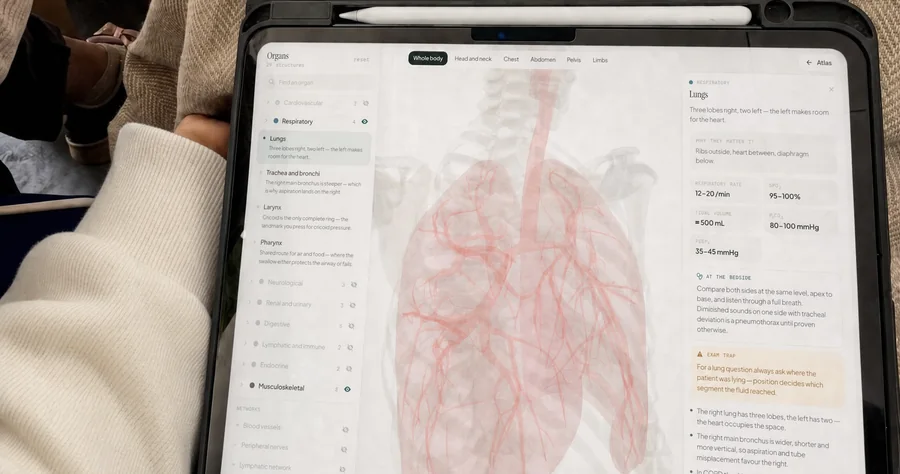
Turn the model in the app. Keep the illustrated book beside you.
FROM OUR STUDENTS
★ Featured reviewKayla B. ✓ Verified
Bridge programme
★★★★★
It explains before it tells
Fifteen minutes on my phone is a whole lesson, and it is done.

Priya S. ✓ Verified
Final year
★★★★★
The atlas is the part I did not expect
Turning the heart around with a trackpad did more in ten minutes than flat diagrams did in a semester.

Renée M. ✓ Verified
Second-career student
★★★★★
It tells you where it came from
Every lesson names the section it came from, and the date it was checked.
THE FULL HANDBOOK, FREE

$7.95 processing today, includes 30 days of app access, then the app subscription continues unless you cancel. All terms shown before checkout.

A REFERENCE TO COME BACK TO
Read all four PDF volumes on your device, or print the pages you want beside your next lesson. The ebook is included with the app; no physical book is shipped.
The $7.95 processing fee gets you the complete four-volume PDF book and your first 30 days of app access. After 30 days the app subscription continues at the price shown before checkout unless you cancel. You can cancel anytime, and every order has a 30-day money-back guarantee.
Your first month of app access includes four nursing courses, 1,221 lessons, 6,745 practice questions and 25 interactive anatomy models. The complete four-volume PDF book is included alongside it.
Yes. Nursing Plan works in your browser on a phone, iPad or laptop. There is nothing to install, and your progress is saved so you can pick up where you left off.
The book is a digital PDF with 130 topics and 2,936 illustrated sheets. Read it on screen or print pages in A4 or US Letter. No physical book is shipped.
LEARN IT. SEE IT. TEST IT.
Start with a lesson. Explore the anatomy. Try a question set. Your first month of app access and the complete PDF book are included for the moments you want to read, review or print.
 30-day money-back guarantee
$7.95 processing today, includes 30 days of app access, then the app subscription continues unless you cancel. All terms shown before checkout.
$7.95 processing today. After 30 days the app subscription continues unless you cancel.